
Most people arrive at the Ireland student visa question with a single practical worry: what does an international student actually need to have in hand before a course in Ireland becomes possible? The answer splits into a few moving parts — the right kind of permission, proof that you can support yourself, medical cover and a course that Ireland formally recognises.
None of it is complicated once the pieces are laid out in order, but the rules differ sharply depending on whether your programme leads to a degree or not and that distinction shapes everything from your work rights to how long you can stay.
This guide walks through who needs a visa, the two study stamps and their very different terms, the money you’ll need to show, what you can earn while studying, a confirmed example of tuition costs and the post-study route that lets graduates stay on and work. Immigration rules change, so treat the figures here as a map rather than a final quote — the sections below point you to the official source for each one.
Who needs an Ireland student visa
The first line to draw is nationality. If you hold a passport from the European Economic Area or Switzerland, you don’t need a visa or immigration permission to study in Ireland at all — Immigration Service Delivery confirms freedom of movement covers this in full. Everyone else is a non-EEA national and the rules in this guide are written for you.
Within that group there are two things that can apply and it helps to keep them separate. A visa is the document that lets you travel to Ireland in the first place. A non-EEA national from a visa-required country who is coming for a course of more than 90 days must apply for the “D” long-stay study visa before travelling. Whether your country is visa-required depends on your nationality — nationals of some countries can enter without one — so check your own status through Immigration Service Delivery rather than assuming.
The second thing applies to every non-EEA student, visa-required or not. Once you’re in Ireland and intend to stay beyond 90 days, you must register with immigration for permission to remain. That registration is where you receive your stamp and the stamp is what actually governs your time as a student. In other words, a visa gets you to the door; registration is what lets you stay behind it.
Stamp 2 versus Stamp 2A
Here is the distinction that decides more than almost anything else, the stamp you receive depends entirely on the course you enrol in.
Stamp 2 is for students on an eligible course. To qualify, the programme must sit at Level 6 or above on the National Framework of Qualifications and appear on the Interim List of Eligible Programmes (ILEP) — the official register of courses that carry full student privileges. Citizens Information and Immigration Service Delivery both list English-language courses of 25 weeks or more on the ILEP alongside higher-education programmes, so it’s the list a course sits on that decides the stamp, not the subject.
Degree-level study at a public university falls squarely here. Stamp 2 comes with a cumulative limit: Immigration Service Delivery caps it at a maximum of seven years studying in Ireland on this basis, extended to eight years if you later use the Third Level Graduate Programme after a Level 9 or 10 degree (more on that further down).
Stamp 2A is for study that isn’t on the ILEP at all — Immigration Service Delivery’s own examples are a semester abroad at an Irish university or college and study at a private secondary school.
It’s a common mix-up to assume English-language study means Stamp 2A: an ILEP-listed English-language course of 25 weeks or more actually carries Stamp 2, with its own tighter conditions attached — at least 85% attendance and a recognised exam at the end of the course and a cap of three such courses for a total of two years’ permission on that basis.
Stamp 2A itself carries no such attendance-and-exam regime, because it isn’t tied to a recognised ILEP qualification route at all. The one point I’d underline most heavily comes in the work section below: Stamp 2A carries no work rights whatsoever.
Because the difference is so consequential, confirm which list your course appears on before you pay a deposit. A programme’s marketing may call it “recognised” without it being on the Interim List of Eligible Programmes and that gap is precisely what separates a Stamp 2 from a Stamp 2A.
The ILEP itself closed to new provider applications in June 2025 and is being phased out in favour of the TrustEd Ireland quality mark awarded by Quality and Qualifications Ireland (QQI) — an existing ILEP listing still stands for now, but check both the ILEP and the TrustEd Ireland providers list before you enrol.
Financial requirements and medical insurance
Ireland wants evidence that you can support yourself without relying on public funds or on the work you’re allowed to do. How much you need to show depends on the length of your course and it’s worth being precise here, because a fair amount of third-party guidance circulating online is out of date.
For shorter courses of roughly six to eight months, Immigration Service Delivery’s own figure is €833 per month, which works out to €4,998 for six months or €6,665 for eight.
For a course of a year or more, the current official figure is clear: €10,000, which Immigration Service Delivery has required as evidence of immediate access to funds for all academic courses beginning after 1 July 2023 and I have reaffirmed this figure is still in force in a June 2025 update. Some older material still quotes €7,000 (a pre-2023 figure) and some third-party sites quote €12,000, but neither matches what Immigration Service Delivery currently publishes.
Treat €10,000 as the figure to plan against and still confirm it directly with Immigration Service Delivery before you assemble your application, since requirements can change. Applying against an outdated number is one of the easier ways to have an application returned and it’s entirely avoidable.
How you evidence the money matters as much as the amount. Citizens Information sets out the expectations clearly: bank statements should cover the last six months, the funds must be genuinely accessible rather than locked in a fixed-term deposit and the account shouldn’t show sudden large deposits that look like borrowed money dropped in to hit the target. Any statement not already in English must be officially translated.
Separate from your living funds, every non-EEA student needs private medical insurance. The minimum cover is €25,000 each for accident and for disease, held for the full year — or for the full length of your stay if the course runs under a year. If your college operates a Group Insurance Scheme, the letter of enrolment confirming your place in it can serve as your proof. As with the financial evidence, insurance documentation must be provided in English.
Working while you study
The stamp you hold changes the picture completely and it’s the reason the Stamp 2 versus Stamp 2A choice is so far-reaching.
A Stamp 2 holder may work up to 20 hours per week during term time, rising to 40 hours per week during holiday periods (holidays run 15 December to 15 January and June to September inclusive). For most degree students that’s enough part-time work to offset living costs without crowding out study and it’s a meaningful part of why Ireland is an attractive destination.
A Stamp 2A holder, by contrast, is not permitted to work at all. This is the stamp for study that sits outside the ILEP altogether, such as a semester abroad or a private secondary school place, so if funding your stay depends on earning while you’re there, that kind of study simply won’t support the plan. Budget for a Stamp 2A placement as though no income is coming in, because none is allowed.
Tuition fees: a confirmed example
Tuition is usually the largest single cost of studying in Ireland and it varies so much between institutions and courses that a blanket “Irish universities charge X” figure would mislead more than it helps. So rather than average across the sector, here is one confirmed example — Trinity College Dublin‘s published non-EU undergraduate fees for the 2026/27 year — to give you a concrete sense of scale.
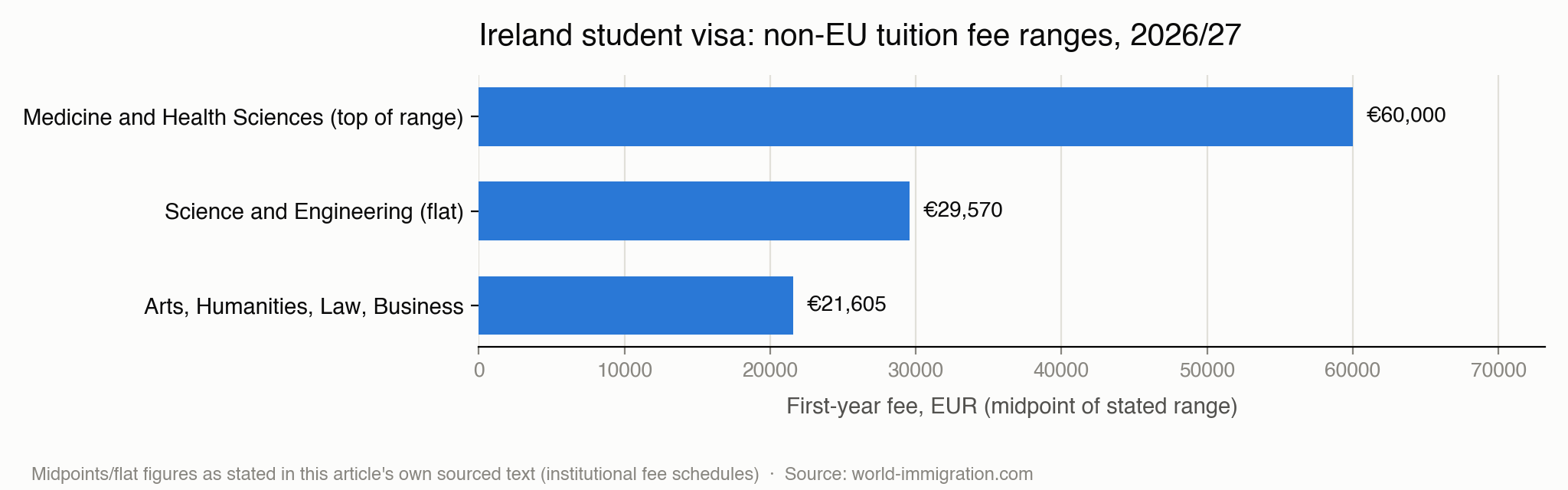
| Course area (non-EU undergraduate) | First-year fee, 2026/27 |
|---|---|
| Arts, Humanities, Law, Business | ~€20,630–22,580 |
| Science and Engineering (incl. Computer Science, Chemistry, Physics) | ~€29,570 (flat) |
| Medicine and Health Sciences | ~€20,750–60,000 per year (Medicine itself sits at the top of this range) |
A couple of details are worth reading alongside that table. The figure of around €60,000 for Medicine and Dental Science at Trinity is a per-year fee, not a total for the whole programme — over a five- or six-year degree the cumulative cost is several times that, so budget it per year rather than as a one-off cap.
And these are Trinity’s figures alone — another university, or another course within the same subject area, can sit well above or below them. Use this as a benchmark for planning, then get the exact fee for your specific course and institution from that institution directly.
Staying on after graduation
One of the stronger reasons to weigh Ireland against other study destinations is what happens when you finish. The Third Level Graduate Programme lets eligible graduates remain in Ireland to look for and take up employment, on a Stamp 1G. The length of that permission depends on your qualification level.
- Level 8 (honours bachelor’s degree): 12 months’ permission, non-renewable.
- Level 9 or 10 (master’s or PhD): an initial 12 months, renewable once for a further 12 months — up to 24 months in total.
There’s a knock-on effect on your overall time in Ireland. Using the Third Level Graduate Programme after a Level 9 or 10 degree extends the student-stay limit from seven years to eight, which gives postgraduate students a little more room across their whole Irish study journey. For anyone planning to convert study into a longer stay or eventual work permit, this route is the bridge between the two.
How and where to apply
All Irish visa applications, the “D” long-stay study visa included, go through AVATS — the online visa application system. You complete the form online, print and sign the summary sheet it produces, then submit it together with your supporting documents. Immigration Service Delivery gives you 30 days from creating the online application to get your supporting documents to them, so starting the form doesn’t lock you into finishing it that same day.
On timing, general guidance puts “D” long-stay visas at around six to eight weeks, with student visas often cited closer to four to eight weeks from the point complete documents are received — but Immigration Service Delivery’s own Visa Decisions page is the only live figure, updated weekly and it moves with demand rather than sitting at a fixed number.
Those are guides, not guarantees and an incomplete file resets the clock. The move I’d make every time is to apply as early as the system allows ahead of your course start date — an early, complete application is the single biggest thing within your control.
This article is part of our Ireland cluster, which covers the full move end to end.
Frequently asked questions
Do I need a visa if my country is not visa-required?
You may not need the “D” long-stay visa to travel, but you still need immigration permission to stay. Every non-EEA student who intends to remain in Ireland beyond 90 days must register with immigration and receive a stamp, regardless of whether their nationality required a visa to enter. So the visa and the permission are two separate steps and the second applies to all non-EEA students.
Can I work while studying English in Ireland?
It depends which stamp your course carries, not whether it’s English-language study specifically. An English-language course listed on the Interim List of Eligible Programmes (25 weeks or more) carries Stamp 2 and you can work up to 20 hours a week in term time and 40 hours a week during holidays, the same as any other Stamp 2 student. Stamp 2A is for study that isn’t ILEP-listed at all — a semester abroad or a private secondary school place are the usual examples — and Stamp 2A holders have no work rights whatsoever.
How much money do I need to show for a one-year course?
The current official figure is €10,000, which Immigration Service Delivery has required as evidence of immediate access to funds for all academic courses beginning after 1 July 2023 (still confirmed current as of a June 2025 update). Older material sometimes quotes €7,000 and some third-party sites quote €12,000, but neither reflects what’s currently published — still confirm the figure directly with Immigration Service Delivery at irishimmigration.ie before you apply, since requirements can change.
Can I stay and work in Ireland after I graduate?
Yes, through the Third Level Graduate Programme on a Stamp 1G. Level 8 honours bachelor’s graduates get 12 months, non-renewable. Level 9 or 10 master’s and PhD graduates get an initial 12 months that can be renewed once, for up to 24 months in total, which also lifts the overall student-stay limit from seven years to eight.
Sources
- Citizens Information — Immigration rules for full-time non-EEA students
- Citizens Information — Visa requirements for entering Ireland
- Immigration Service Delivery — Immigration permission/stamps
- Immigration Service Delivery — EU/EEA country or Switzerland
- Immigration Service Delivery — Interim List of Eligible Programmes (ILEP)
- Immigration Service Delivery — Information on Student Finances
- Immigration Service Delivery — Reminder on Student Finance requirements from 30 June 2025
- Immigration Service Delivery — Third Level Graduate Programme
- Immigration Service Delivery — Private Medical Insurance
- Immigration Service Delivery — How to apply for long term study visa
- Immigration Service Delivery — Visa Decisions (live processing times)
- Trinity College Dublin — Fees

