
The first question most people ask before buying property in Ireland is not about price or location. It is whether they are even allowed to buy at all. Ireland has a reputation as a tightly held place, so the assumption that a passport or a residence stamp gates the market is understandable.
It is also wrong. Foreigners buy Irish homes on the same legal footing as Irish citizens and the harder parts of the exercise are the ones that trip up locals too: a buying process with no binding stage until late, transaction costs that stack up quietly and a mortgage market that treats non-residents with visible caution.
This guide walks through what buying property in Ireland actually involves for someone coming from outside the country, from the ownership rules through to the traps that only show up once you are committed. Where a figure or a rule matters, I have pointed to the institution that sets it rather than asking you to take my word for it.
Buying property in Ireland: can a foreigner even do it?
Yes and without qualification. There are no residency-based restrictions to buying property in Ireland — the same official guidance states plainly that an Irish citizen, an EU/EEA citizen, a non-EEA national and a non-resident all buy on the same footing. No residency requirement, no EU-citizenship test and no special permission from any authority. A non-resident buyer sits under the same conveyancing law, the same stamp duty rates and the same title system as a citizen who has lived down the road for forty years. This is the single biggest myth to clear away early, because it changes how you plan everything that follows.
One administrative step does apply regardless of where you live. To complete a purchase you need a PPSN, the Personal Public Service Number, because the e-stamping and Land Registry registration that finalise the sale cannot be processed without one. Ownership itself is unrestricted, but the paperwork that records that ownership runs through the PPSN, so a non-resident buyer should treat obtaining one as an early task rather than a last-minute scramble.
A word on motive – Buying a house in Ireland does not, on its own, grant any right to live there. The Immigrant Investor Programme, which once offered a residency route tied to qualifying investment, closed to new applications in February 2023. Property and immigration are now separate questions in Ireland and we cover the residency side in a dedicated article elsewhere on this site. Here the assumption is simply that you want to own a home, whether as a base, a holiday place or an eventual retirement.
The buying process
Properties in Ireland are bought and sold either by private treaty or public auction. Private treaty is the ordinary open-market process: an asking price, viewings, offers back and forth. Auction sales exist and get a lot of attention, but they are the minority. The distinction matters more than it first appears, because the two routes behave very differently once you are the interested party.
Under private treaty, an accepted offer binds nobody. The contract for sale is what binds the parties to completion and any booking deposit paid to an estate agent along the way is refundable up to the point that contract is signed — which happens well into the process after searches and finance are in place. Up to that point either side can walk away or change terms.
Auction is the opposite. The successful bidder signs the contract for sale and pays a deposit immediately when the hammer falls and the sale is binding from that moment. Auctioneers and conveyancing solicitors commonly describe that deposit as around 10% and completion as typically following within about four weeks, though neither figure is fixed by any regulator — treat them as a planning range, not a rule. Certainty is the trade-off there and it cuts both ways. My reading is that a first-time foreign buyer is usually better served by the slower private-treaty route, provided they understand that “accepted offer” may mean less in Ireland than it might at home.
A solicitor is effectively not optional, even though nothing in law forces you to hire one. Official guidance describes a solicitor’s conveyancing role as standard practice at every stage of an Irish purchase — checking the contract for sale and title documents, raising Requisitions on Title, drafting the Deed of Conveyance, calculating and paying stamp duty and registering the deeds with Tailte Éireann. In practice almost nobody completes a purchase without one.
For a buyer arriving from a system where an estate agent or a notary does much of this, the central position of the solicitor is one of the first things to adjust to. Choose one early, ideally before you have found a property, so that when an offer is accepted you are not losing days finding representation.
On timing, Irish conveyancing solicitors commonly quote roughly eight to twelve weeks for a standard private-treaty purchase, from accepted offer to completion. Older properties, unclear title or anything with a planning challenge can stretch that considerably and auction complications can too. No regulator sets this figure, so treat it as a planning baseline rather than a promise.
What it costs to complete the purchase
The headline price is only part of the outlay. Stamp duty, professional fees, searches and registration all sit on top and an ongoing annual property tax begins once you own. Stamp duty on residential property, for instruments executed from 2 October 2024, is tiered: 1% on value up to €1 million, 2% on the slice from €1 million to €1.5 million and 6% on anything above €1.5 million.
A separate 15% rate applies to bulk purchasers who acquire ten or more houses in a twelve-month period, under Section 31E of the Stamp Duties Consolidation Act 1999. This does not touch an individual buyer or apartment purchases, but it is there in the rules and occasionally causes confusion.
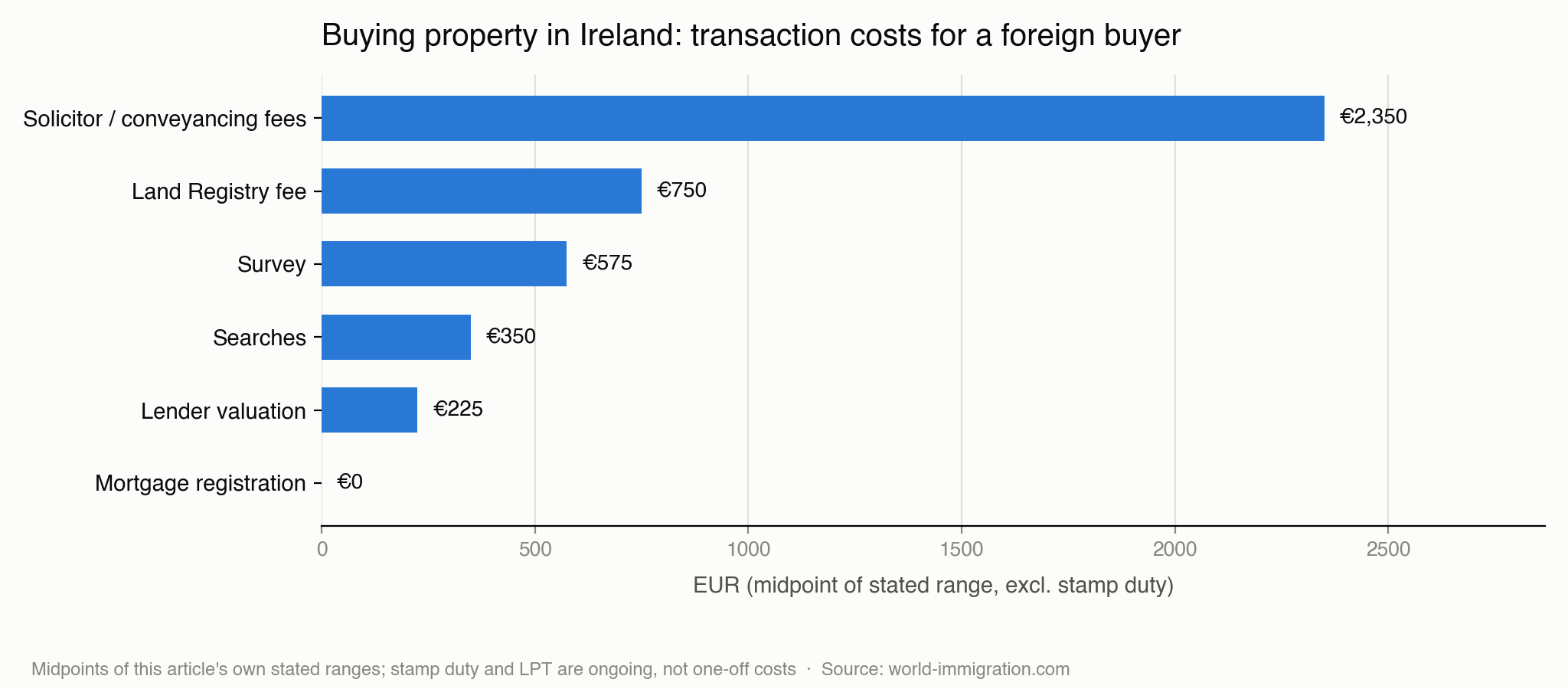
The table below sets out the main costs a foreign buyer should budget for. Figures are indicative and depend on the property and provider, so treat them as a planning range rather than a quote.
| Cost | Typical range | Notes |
|---|---|---|
| Stamp duty | 1% up to €1m | 2% on €1m–€1.5m, 6% above €1.5m |
| Solicitor / conveyancing fees | €950–€2,500 plus VAT | No fixed rate — Citizens Information advises comparing quotes; range reported by moneyguideireland.com |
| Survey | €350–€500 plus VAT | For a structural survey, per moneyguideireland.com; varies with survey type and property size |
| Searches | €150–€350 | Title, planning and environmental searches; figure varies by provider |
| Lender valuation | €150–€250 | Required where a mortgage is involved, per moneyguideireland.com |
| Land Registry fee | €400–€800 | Tiered by price band under the Land Registration Fees Order 2012 (Tailte Éireann) — €400 up to €50,000, rising in bands to €800 above €400,000 |
| Mortgage registration | €0 | Fee waived for electronic registration via Tailte Éireann (S.I. No. 677/2023, in effect 1 Jan 2024 – 31 Dec 2026); only paper filings still attract the historic €175 charge |
| Local Property Tax | Ongoing annual | 0.0906% of market value up to €1.26m; see below |
Local Property Tax is the one recurring cost, charged every year for as long as you own. A national revaluation took effect on 1 November 2025 for the 2026–2030 valuation period, at a rate of 0.0906% of market value up to €1.26 million, with higher marginal bands above that.
The revaluation sounds alarming after several years of price growth, but for most owners of properties valued up to €525,000 it translated to an increase of only about €5 to €25 a year, according to the Department of Finance. It is a cost to plan for, not one to lose sleep over.
Getting a mortgage as a non-resident
Irish banks do lend to non-residents and expatriates, but the terms are noticeably tighter than for someone living and earning locally. The pattern I see repeated across lenders is a minimum deposit around 30%, against the 10% a resident first-time buyer might put down.
Self-employed applicants are not shut out, but the documentation bar is materially higher than for a salaried employee. AIB’s own published requirements ask for two years of audited or trading accounts, two years of Revenue-acknowledged Form 11s, an accountant’s or ROS confirmation of tax position and six months of business bank statements, on top of the personal documentation every applicant provides. An income threshold of roughly €75,000 or more is common at some lenders, though the exact figure depends on the bank and whether the application is sole or joint. Permanent TSB looks for at least €75,000 whether the application is single or joint, while Bank of Ireland wants €75,000 for a sole applicant but €125,000 for a joint one; other lenders assess affordability without a fixed minimum. Lenders verify income through bank statements, payslips and tax documents covering roughly the past year and non-resident mortgages are commonly capped at a 25-year term rather than the 30 years available to residents, according to several mortgage brokers.
All of this layers on top of the general lending framework set by the Central Bank of Ireland, which applies to every buyer. That framework caps borrowing by Loan-to-Income at four times gross income for first-time buyers and 3.5 times for second-time-and-subsequent buyers, with up to 15% of each lender’s annual first-time and second-time-buyer lending permitted to exceed those caps (10% for buy-to-let lending).
On Loan-to-Value it allows up to 90% for both first-time and second-and-subsequent buyers alike, a minimum 10% deposit with no property-price threshold attached (buy-to-let borrowing is capped separately, at a minimum 30% deposit). A non-resident sits inside those rules and then faces the stricter roughly 30% deposit norm on top. If I were advising someone planning this from abroad, my first step would be to get an agreement in principle from an Irish lender before house-hunting in earnest, because the deposit gap is where non-resident purchases most often stall.
What houses actually cost
The Central Statistics Office tracks this through its Residential Property Price Index. For the twelve months to March 2026 the national median price was €390,461, with the index up 6.5% year-on-year. Dublin, predictably, sits well above the national figure at a median of €500,000. What surprises people is that prices outside Dublin rose faster than the capital over that year, up 7.2% against Dublin’s 5.7%, so the gap has been narrowing rather than widening.
The county spread is wide. The cheapest counties, Donegal and Longford, showed medians around €200,000, roughly half the national figure. Outside Dublin the most expensive county was Wicklow at about €462,000, which reflects its commuter pull toward the capital and its scenery. For a foreign buyer the takeaway is that “the price of an Irish house” is close to meaningless as a single number. Where you buy moves the figure by a factor of two or more and the fastest growth is currently in the regions rather than Dublin.
Traps that catch newcomers
Two problems stand out for buyers arriving from elsewhere and neither is obvious from the outside.
The first is gazumping. Because nothing binds until the contract for sale is signed, a seller can accept a second, higher offer after already accepting yours and there is no legal obstacle to them doing so. You can spend money on a survey and solicitor’s searches only to be outbid at the last moment.
This practice, known as gazumping, is legal in Ireland and reasonably common in a rising market. The defence is speed: move quickly on the survey, the conveyancing and the finance so that the window in which you are exposed is as short as possible. The buyer who takes three weeks to instruct a solicitor is the buyer who gets gazumped.
The second is rural planning and it can undo a dream before it starts. Government policy is explicit that people “who are an intrinsic part of the rural community based on economic or social need” are the ones supported to build there and in practice, many county development plans apply this through a “local needs” clause attached to permission for a one-off house in the countryside. Planners may require proof of a genuine social or economic tie to the area, such as long-term residency, a farming livelihood or family land, before granting permission for a new rural dwelling. For a foreign buyer eyeing a self-build or a site that already carries permission, this is a serious obstacle.
Some sites also carry enurement clauses that restrict who may live in or resell the resulting house. A national reform of these rules is in progress but is not law yet. The Draft Sustainable Rural and Gaeltacht Housing National Planning Statement, cabinet-approved in June 2026, would replace the current patchwork with a single national local-need test: seven years’ residence, continuous or cumulative, within 10km of the site, extended to returning emigrants and people who grew up in the area, plus a separate economic-need route limited to farmers and essential-service workers such as teachers and healthcare staff — remote workers are explicitly excluded from that route. Settlements under 1,500 people would be exempt from the local-need test altogether and minimum road frontage and site-size rules would be scrapped nationwide. Gaeltacht areas would keep a tighter version of the test: a 3km radius and ten years’ residence, or five years for an Irish speaker who can show local need. None of this has taken effect yet, so check the current version of your local county development plan and take planning advice before committing to a rural site.
This article is part of our Ireland cluster, which covers the full move end to end.
Frequently asked questions
Can I buy a house in Ireland without living there?
Yes. There is no residency requirement to own residential property in Ireland and a non-resident buys on the same legal terms as a citizen. You will need a PPSN to complete the registration and, if you are borrowing, an Irish lender will apply stricter non-resident terms than it would to a local buyer.
Does buying property give me the right to live in Ireland?
No. Owning a home confers no immigration status on its own. The Immigrant Investor Programme that once linked investment to residency closed to new applications in February 2023, so property and the right to live in Ireland are now separate matters.
How much deposit does a non-resident need for an Irish mortgage?
Expect a minimum around 30%, against the 10% available to resident first-time buyers. Salaried and self-employed applicants are both considered, though a self-employed file needs more — typically two years of accounts and tax returns plus an accountant’s confirmation. Lenders want an income of roughly €75,000 or more at some banks (higher for a joint application, such as Bank of Ireland’s €125,000), verified through payslips, bank statements and tax documents, with non-resident mortgages commonly capped at a 25-year term according to several mortgage brokers — all sitting within the Central Bank of Ireland’s general lending caps.
What is gazumping and can it happen to me?
Gazumping is when a seller accepts a higher offer after already accepting yours. It is legal in Ireland because nothing binds either party until the contract for sale is signed, which comes late in the process. Moving quickly on your survey, conveyancing and finance is the main way to reduce your exposure.
Sources
- Citizens Information — Steps involved in buying a home (foreign-ownership rule, private treaty/auction process, contract binding)
- Revenue.ie — Stamp duty rates on a transfer of residential property
- Citizens Information — Stamp duty on property (PPSN requirement)
- gov.ie — Changes to Local Property Tax
- Central Bank of Ireland — Mortgage Measures
- bonkers.ie — Applying for a mortgage in Ireland as a non-resident (lender-by-lender criteria)
- AIB — Documentation required for self-employed / company-director mortgage applicants
- Tailte Éireann — Registering a Mortgage Charge (electronic fee waiver)
- Tailte Éireann — Land Registration Fees Order 2012, “What are the Fees for…?”
- MoneyGuideIreland — Legal and associated fees for buying a house
- The Irish Times — Gazumped, gazundered and traumatised
- CSO — Residential Property Price Index, March 2026
- Setanta Solicitors — “Locals only” rules in Irish planning law
- gov.ie — Rural Housing Guidelines (Department of Housing, Local Government and Heritage)
- TheJournal.ie — One-off housing: the new rules explained (Draft Sustainable Rural and Gaeltacht Housing National Planning Statement, June 2026)

