
Ask anyone planning a move about medical cover and two questions come up first: how does the system actually work and what will it cost me when I turn up sick. The Ireland healthcare system answers those questions in a way that surprises people who arrive expecting either a British-style free-at-the-point-of-use model or an American-style pay-for-everything one. It is neither.
Ireland runs a public system funded through general taxation alongside a large, well-established private sector and most residents end up using both. This guide walks through what the public Health Service Executive (HSE) covers, what it charges, why so many people carry private insurance on top and what the rules mean for you depending on the visa or citizenship you arrive with.
How the Ireland healthcare system works: HSE costs explained
The HSE is the state body that runs public hospitals, primary care and community services. Everyone ordinarily resident in Ireland is entitled to public care, but “entitled” does not mean “free at every step”. The system has a set of standard charges and the layer that is perhaps a surprise is the general practitioner (GP) visit.
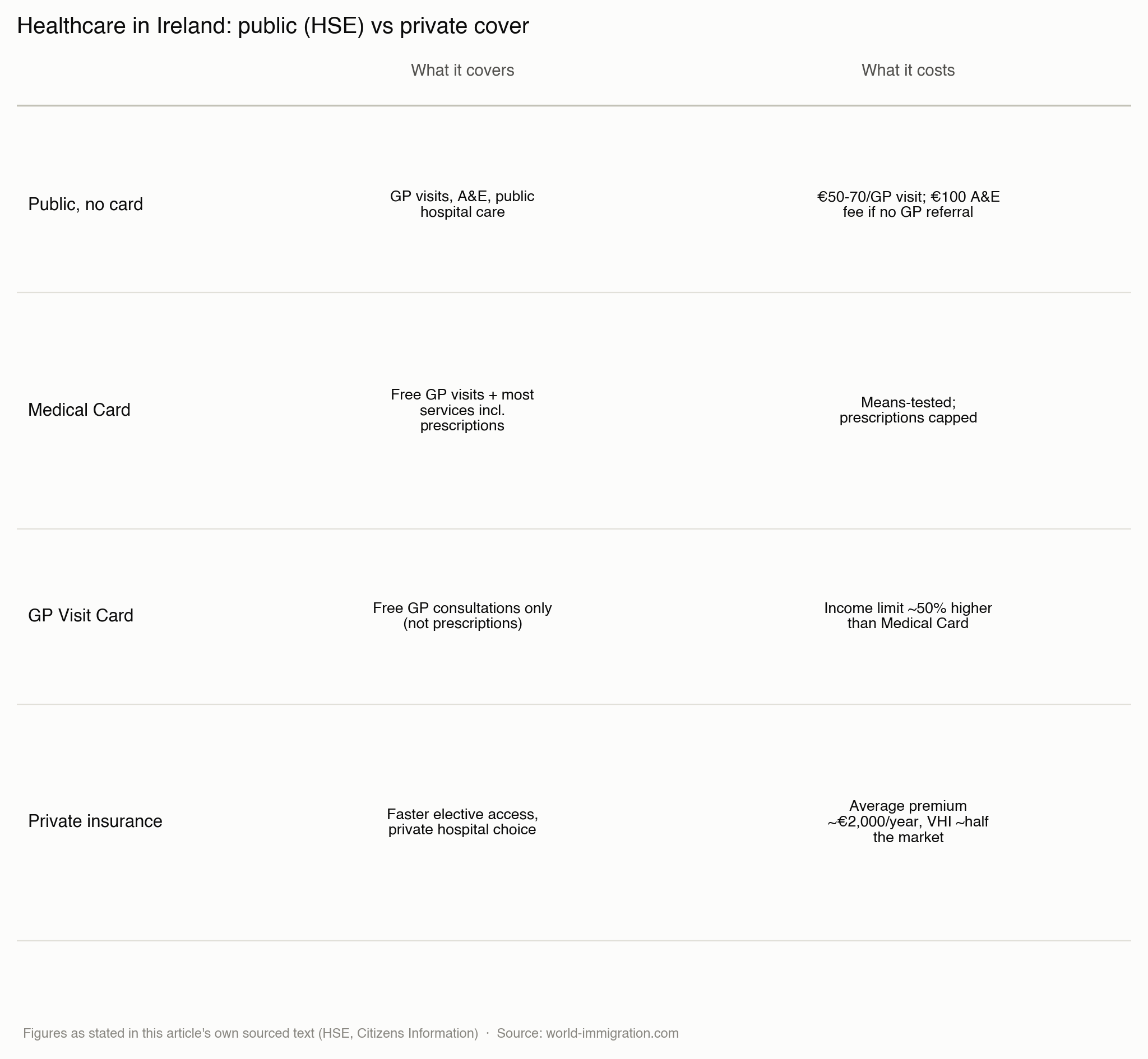
Unlike the UK, seeing a GP in Ireland is not free by default. A standard consultation for someone paying out of pocket typically runs €50 to €70 per visit and you pay it there and then. Prescriptions are charged separately at the pharmacy. That is the baseline most working-age arrivals will face.
Two means-tested cards change the picture. The Medical Card, assessed on income, gives holders free GP visits and most public health services including prescriptions at a small capped charge. People aged 70 and over qualify for GP care without the usual income test. A step below sits the GP Visit Card, which covers free GP consultations only (not free prescriptions) and applies at income limits roughly 50% higher than the Medical Card thresholds. Children under eight qualify for a GP Visit Card regardless of household income, which is a useful thing for families to know before they budget.
Emergency departments carry their own charge. If you attend accident and emergency (A&E) without a GP referral, the standard fee is €100, billed by post several weeks after the visit rather than collected at the door. That charge is waived if your GP referred you, if you are admitted to hospital from A&E or on hardship grounds. My reading of it is that the fee exists mainly to steer non-urgent cases toward a GP first, not to bill genuine emergencies.
Here is the correction that matters, because a lot of older material online still gets it wrong. Ireland used to charge public inpatients €80 per night, capped over a year. That charge was abolished on 17 April 2023 under the Health (Amendment) Act 2023. As of 2026, public inpatient and day-case hospital care is free for everyone, regardless of whether you hold a Medical Card. If you read an article quoting an €80 nightly bed charge, it is out of date and no longer applies.
Waiting times: the 2026 targets versus the actual lists
The pressure point in Irish public healthcare is not cost so much as time. The Department of Health published its Waiting Time Action Plan 2026, which restates the longer-term Sláintecare targets of a maximum 10 weeks for an outpatient appointment and 12 weeks for an inpatient or day-case procedure and gastrointestinal scopes. The interim goal for 2026 is more modest: getting 50% of patients seen within the outpatient and inpatient/day-case targets and 65% within the 12-week gastrointestinal-scope target.
The current numbers show why the interim goal is framed the way it is. National Treatment Purchase Fund figures at the end of May 2026 recorded 669,506 people waiting for a first outpatient appointment, up by around 82,000 (roughly 14%) year on year. Across all public waiting lists combined the total sits at about 1,008,600 people.
Put those two things side by side and the ambition of a 10-week target against a list that is still growing tells you where the strain is. This gap is the single biggest reason private insurance is as common as it is, which brings us to the next section.
Private health insurance: normalised, not a replacement
Around 46% of the population, roughly 2.55 to 2.6 million people, held private health insurance in 2025 to 2026, a figure that has crept up rather than fallen. That level of uptake is unusual for a country with universal public entitlement and it tells you how residents actually behave: they treat private cover as normal, not as a luxury. Average premiums sit near €2,000 a year and have been rising, by a meaningful margin, as claims costs climb.
Four names cover most of the market. VHI Healthcare is the largest by some distance, holding around half of it. Laya Healthcare and Irish Life Health make up much of the rest, with Level Health as a newer entrant. Ireland operates community rating, meaning insurers charge the same base price for a given plan regardless of your age or health when you first take it out, which keeps the market accessible to older arrivals in a way that risk-rated systems do not.
What private cover actually buys is the point people get wrong. It pays for private or semi-private hospital rooms and faster access to elective (planned, non-emergency) procedures, letting you skip the public waiting list for the treatments it covers. What it does not do is replace public primary or emergency care. Insured people still see HSE GPs and still go through public A&E in the ordinary course; the insurance sits on top for elective hospital work rather than underneath everything.
One detail to plan around: a new illness usually carries a 26-week waiting period before elective private claims on it become payable, so buying cover the week before a planned procedure will not help. The way I would frame it is that private insurance in Ireland buys speed and comfort for planned care, not a separate healthcare system.
EU citizens, the EHIC and non-EU visa insurance rules
Your route into the system depends heavily on your nationality and immigration permission:
EU and EEA citizens who move to Ireland apply for an Irish European Health Insurance Card (EHIC) through the HSE once they are resident, which needs a Personal Public Service (PPS) number and proof of address. A word of caution here that catches EU movers out: the EHIC (and the UK’s GHIC) only covers public-system treatment while you are temporarily in another EU state.
It is not the mechanism for your ordinary, residence-based care once you actually live in Ireland; residence-based entitlement is what covers you day to day. UK nationals need a fresh Irish PPS number, because a British National Insurance number does not transfer across.
For non-EEA immigrants the rules are stricter and, in several cases, mandatory. Private medical insurance is a written condition of certain immigration permissions rather than an optional extra. Stamp 0, the permission used by people of independent means and some retirees, requires evidence of private medical insurance with full cover in private hospitals, maintained for the entire duration of the permission. Some third-party immigration guides describe this as needing to match VHI’s Plan D level, but Immigration Service Delivery applies that named standard specifically to the elderly-dependent-relative category of Stamp 0, not to people of independent means or retirees.
Stamp 2, the student permission, requires private medical insurance carrying a minimum of €25,000 cover each for accident and for illness. If you are arriving on either, the cover is not something to sort out later; it is part of what keeps your permission valid.
Registering with a GP as a newcomer
Finding a GP is the first practical task once you land and it is less automatic than in some countries. You are not assigned a doctor; you register with a practice yourself. The HSE runs a “Find a GP” online tool that lets you search by county or town, which is the sensible starting point. In practice, a recommendation from a colleague or neighbour often beats a practice website, since those sites are frequently out of date on whether they are taking new patients.
Location changes the difficulty sharply. Relocation guides report Dublin as the hardest place to register, because many city practices operate closed lists and are not accepting new patients at all. Newcomers there sometimes have to contact several practices before one takes them, so I would start that search early rather than waiting until you are unwell.
Registration itself means completing a new-patient form with your personal and medical details and your previous clinic, plus photo ID and proof of address. It pays to request a transfer of your medical records and vaccination history from your home-country GP at the same time, so your new practice starts with your full picture rather than a blank page.
What this guide can’t tell you
A reference article can map the structure, the charges and the rules and that is what this one has done. What it cannot do is quote your premium or confirm exactly what a given plan covers for your circumstances. Insurance pricing turns on age at first cover, the plan tier, excess levels and the specific hospitals and procedures included and those details shift between insurers and between plan years.
For an actual figure and for confirmation that a policy meets a Stamp 0 or Stamp 2 requirement, use an insurance broker or contact the insurers directly rather than relying on a general guide. The same applies to Medical Card eligibility at the margins, which depends on a full assessment of your income and outgoings.
This article is part of our Ireland cluster, which covers the full move end to end.
Frequently asked questions
Is healthcare in Ireland free?
Partly. Public inpatient and day-case hospital care is free for everyone since the €80 nightly charge was abolished in April 2023. Emergency department attendance costs €100 unless it is waived and GP visits are not free by default, typically €50 to €70 unless you hold a Medical Card or GP Visit Card.
Do I need private health insurance to live in Ireland?
Not always, but sometimes yes. Everyone resident has public entitlement, so private cover is optional for most EU and EEA residents. For non-EEA immigrants on certain permissions it is mandatory: Stamp 0 requires private medical insurance with full cover in private hospitals and Stamp 2 students need at least €25,000 cover each for accident and illness.
How long are the public waiting lists?
Long and growing. At the end of May 2026 about 669,506 people were waiting for a first outpatient appointment, up around 14% year on year, with roughly 1,008,600 across all public lists. The 2026 targets aim for a maximum of 10 weeks for outpatient appointments and 12 weeks for procedures, but the interim goal is only to reach half of outpatient and procedure patients within those times (65% for GI scopes).
How do I register with a GP when I arrive?
Use the HSE’s “Find a GP” tool to search your county or town, then contact practices directly, since you register yourself rather than being assigned. You will complete a new-patient form and provide ID and proof of address. Start early in Dublin, where many practices have closed lists and ask your former GP to transfer your records and vaccination history.
Sources
- gov.ie — Abolition of public hospital inpatient charges (Health (Amendment) Bill 2023)
- gov.ie — Waiting Time Action Plan 2026
- The Irish Times — Nearly half the population now reliant on private health insurance as claims soar
- HSE.ie — Apply for a European Health Insurance Card (EHIC)
- Citizens Information — Private health insurance and the public system
- Citizens Information — Entitlement to public health services
- Citizens Information — GPs and private patients
- Citizens Information — Medical cards
- Citizens Information — GP visit cards
- Citizens Information — GP visit cards for children under 8
- Citizens Information — Hospital charges (A&E fee and waivers)
- National Treatment Purchase Fund — Waiting List Data
- Irish Examiner — Less than half of population pays for health insurance as average cost jumps
- Health Insurance Authority — Market reports and bulletins
- Health Insurance Authority — Waiting periods
- Citizens Information — The European Health Insurance Card
- Citizens Information — Personal Public Service (PPS) number
- Immigration Service Delivery — “I want to retire to Ireland” (Stamp 0 insurance requirement)
- HSE.ie — Find a GP
- Citizens Information — Health care in Ireland (for new residents)
- Settle.ie — Finding and registering with a GP in Ireland (secondary source, Dublin closed-lists point)

