
The first question most people ask when they size up a move to Ireland is a simple one: what will I actually earn? It sounds like it should have a single answer and the trouble is that it does not. Ask for the average salary in Ireland and you will be handed numbers that sit thousands of euro apart, all of them correct, all of them measuring slightly different things.
The gap between them is not a rounding error or a stale statistic. It is the whole story and it comes down to the difference between a mean that a handful of very high earners drag upward and a median that tells you where the middle of the workforce actually sits.
My aim here is to give you both figures side by side, labelled by who published them and for which year, so you can see which one answers your question rather than trusting a headline number that flatters the country. The Central Statistics Office (CSO) publishes two separate earnings series and reading them together is the only way to get an accurate picture of the average salary in Ireland.
Ireland’s two-speed pay picture
Ireland runs what is effectively a two-speed labour market and the two CSO datasets each capture a different speed. If you blend them into one figure you lose the thing that matters most. So here they are, kept apart on purpose.
The first is the CSO’s Earnings and Labour Costs release (ELCQ), a quarterly survey of enterprises. Its preliminary estimate for Q1 2026 puts average weekly earnings at €1,075.58, up 4.4% on the €1,029.81 recorded a year earlier, with average hourly earnings of €33.14. The final figure for Q4 2025 was slightly lower at €1,011.88, a 3.1% annual rise. The CSO does not officially turn these into an annual salary, but multiply a weekly figure by 52 and you land somewhere around €53,000 to €56,000 a year.
The second is the CSO’s Earnings Analysis using Administrative Data Sources (EAADS), an annual release built from tax records rather than a survey. Because it draws on administrative data it covers close to the entire employed population and its most recent full year is 2024. It reports mean weekly earnings of €942.73, roughly €49,000 a year and a median of €730.89, roughly €38,000 a year.
That median sits well below both the mean and the quarterly survey figure and the difference is the point. When mean and median part company by that much, it tells you the distribution is lopsided: a top layer of very well-paid roles pulls the average up while most people earn considerably less. The CSO’s own EAADS 2024 data implies that around two-thirds of employees earn below the mean.
If you want to know what a typical worker takes home, the median of about €38,000 is the figure I would anchor to. If you want to know what the survey of employers reports across the higher-paid, faster-growing end of the market, the ELCQ’s €53,000-plus is the one and it climbs faster each quarter because that is where the pay pressure is concentrated.
Neither number is wrong. They answer different questions. The multinational tech, pharmaceutical and financial-services employers clustered around Dublin pay salaries that would look at home in San Francisco or Zurich and they lift every average that includes them. Step outside that band into retail, hospitality or care work and the picture changes entirely. A single blended “average salary in Ireland” hides exactly the variation a person planning a move needs to see.
What different sectors pay
Sector is the single largest driver of where you will fall in that spread and the EAADS 2024 medians make the range stark. These are median weekly earnings, so half the workers in each sector earn more and half earn less.
- Information & Communication — €1,440.36 (the highest-paid sector by a clear margin)
- Financial, Insurance & Real Estate — €1,027.24
- Public Administration & Defence — €993.09
- Arts, Entertainment, Recreation & Other Services — €454.34
- Accommodation & Food Services — €391.62 (the lowest)
The top and bottom of that list differ by more than three and a half times. A median Information & Communication worker earns near €75,000 a year — the EAADS 2024 weekly median annualised over 52 weeks — while a median hospitality worker sits close to €20,000. This is the two-speed economy expressed in a single column of numbers. It also explains why the country-wide average is so sensitive to how many tech and finance salaries a given dataset happens to include.
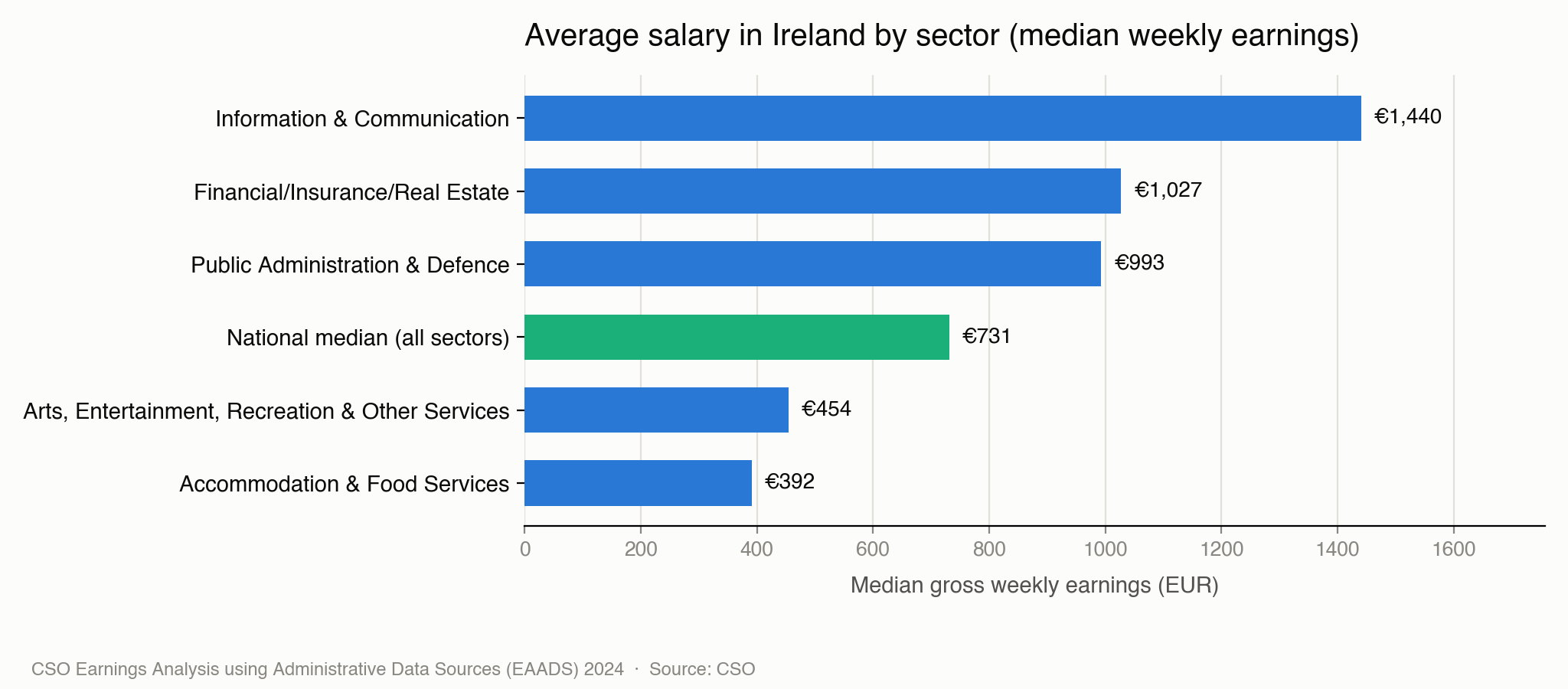
If you are weighing a move around a specific job offer, compare it against the median for its sector rather than the national figure. An offer that looks strong against the country-wide €730.89 median might be middling for Information & Communication and generous for Accommodation & Food Services. The sector benchmark is the more useful yardstick.
Where you live: the Dublin question
Geography matters too, though less dramatically than some parts of the internet suggest. Dublin has the highest regional earnings in the state at a median of €821.42 a week per the EAADS 2024 figures. Set against the state median of €730.89, that is a premium of 12.4%.
I flag that figure deliberately, because you will find sources online quoting a much larger Dublin premium, sometimes around 32%. Those numbers tend to compare mismatched datasets or mix full-time survey means with population-wide medians. The CSO’s own like-for-like comparison puts the gap at 12.4% and that is the number I would trust.
Dublin pays more, but the difference is closer to one part in eight than one part in three. Given that Dublin also carries the country’s steepest rents, a 12% pay bump can be swallowed quickly by housing costs, which is a calculation better made against local rent than against the salary premium alone.
Gross versus take-home: tax, USC and PRSI
Every figure above is gross and Ireland’s deductions are substantial enough that gross and net can feel like two different salaries. Three separate charges come off your pay, listed below:
Income tax runs on two rates. Under Budget 2026 a single person pays 20% on earnings up to €44,000 and 40% on everything above that. The standard-rate band widens if you are married: €53,000 for a one-earner couple and up to €88,000 for a two-earner couple.
On top of income tax sits the Universal Social Charge (USC), a separate levy with its own bands for 2026: 0.5% up to €12,012, 2% up to €28,700, 3% up to €70,044 and 8% above that. If your total income for the year is €13,000 or less you are exempt from USC entirely.
The third charge is Pay Related Social Insurance (PRSI), which funds social welfare and the state pension. The employee rate is 4.2% through September 2026 and rises to 4.35% from 1 October 2026.
Add those together at the top and the marginal rate is what surprises people. On any income above €70,044 you pay 40% income tax, 8% USC and about 4.2% to 4.35% PRSI, a combined marginal rate near 52%. That does not mean you lose 52% of your whole salary, only of each euro earned above that threshold, since the lower bands are taxed at their lower rates first.
Still, it explains why a well-paid Dublin tech role does not translate into as large a take-home lead as the gross figure implies. When you compare an Irish offer against one elsewhere, model the net rather than the headline.
The floor: minimum wage
For a sense of the bottom of the market, the national minimum wage rose to €14.15 an hour on 1 January 2026, up from €13.50 in 2025, for workers aged 20 and over. Lower sub-rates apply to under-20s on a sliding scale by age. A full-time week at that rate lands well below every median above, which is a reminder that the country-wide figures are built on a wide base and that entry-level and part-time roles sit some way beneath them.
One more distributional detail from the EAADS 2024 data is worth carrying with you. The gender gap in median weekly earnings is €148, with men at €802.14 and women at €654.07. It is a structural feature of the numbers rather than a quirk of one sector and it is another reason the single national average tells you less than the breakdowns behind it.
So what should you actually expect?
If I had to compress all of this into a working answer, it would be this. A typical Irish worker earns a median of about €730 a week, or roughly €38,000 a year, before tax. The employer survey reports higher and rising averages above €1,000 a week, driven by the multinational band and the sectors around it.
Your own likely earnings depend far more on your sector and your role than on any national figure and Dublin adds a modest 12% rather than the outsized premium some sources claim. Take-home is meaningfully below gross once income tax, USC and PRSI are applied. Hold those five points together and you have a picture the often quoted single number can never give you.
This article is part of our Ireland cluster, which covers the full move end to end.
Frequently asked questions
What is the average salary in Ireland in 2026?
There are two defensible answers. The CSO’s quarterly employer survey reports average weekly earnings of €1,075.58 for Q1 2026, roughly €53,000 to €56,000 a year on a 52-week basis. The CSO’s tax-data analysis for 2024 gives a lower and more representative median of €730.89 a week, about €38,000 a year. The first captures a higher-paid slice of the market, the second captures the middle of the whole workforce.
Why is the median so much lower than the average?
Because a concentrated band of very high earners in tech, pharmaceuticals and finance pulls the mean upward while most people earn less. When the mean sits well above the median, the distribution is skewed and CSO EAADS 2024 figures imply roughly two-thirds of employees earn below the mean. The median is the better guide to what a typical person takes home.
Which sector pays the most in Ireland?
Information & Communication, at a median of €1,440.36 a week per the EAADS 2024 data, clearly ahead of Financial, Insurance & Real Estate at €1,027.24. At the other end, Accommodation & Food Services sits lowest at €391.62 a week.
How much of my salary goes to tax in Ireland?
A single person pays 20% income tax up to €44,000 and 40% above that, plus USC on a sliding scale and PRSI of 4.2% (rising to 4.35% from October 2026). The combined marginal rate on income over €70,044 is around 52%, though that applies only to each euro above the threshold rather than your whole salary, so your effective rate is lower.
Sources
- CSO — Earnings and Labour Costs, Q4 2025 final and Q1 2026 preliminary estimates
- CSO — Earnings Analysis using Administrative Data Sources 2024
- Citizens Information — National minimum wage

