
Is Ireland a good place to live? Most people asking are probably not asking in the abstract. They are probably weighing it against wherever they sit right now — a rented flat in a British city, a house in a US suburb, a life somewhere that has stopped fitting. So the useful answer is not a brochure. It is a comparison and comparisons only work when the trade-offs are laid out with actual figures rather than mood.
Ireland genuinely does several things well. It is safe, it is welcoming by reputation and largely by experience and its landscape earns the postcards. It also has one dominant problem — housing — that can undo all of that for the wrong person at the wrong time. Whether Ireland is a good place to live depends almost entirely on whether you can solve the roof over your head before you arrive. Everything else is a manageable adjustment. That one is not.
What Ireland genuinely gets right
Start with safety, because it is measurable rather than felt. Ireland ranks fifth in the 2026 Global Peace Index, behind only Iceland, New Zealand, Switzerland and Slovenia. Forbes, reporting the index in June 2026, put the placing down to low militarisation and a stable political environment. That is a top-five position on a global measure, not a marketing line and it shows up in ordinary life as a country where most people feel comfortable in most places at most hours.
The friendliness reputation is harder to quantify but consistent enough to treat as genuine. Ireland trades on being sociable and open to newcomers and while any national stereotype flattens the exceptions, the aggregate experience people report is a country where conversation comes easily and community forms without much effort. If you are moving somewhere cold and anonymous, that matters.
The landscape needs no defending. The west coast in particular — Kerry, Clare, Donegal — is the kind of scenery people cross oceans to photograph and it is a twenty-minute drive from ordinary towns rather than a national-park pilgrimage. Green, dramatic and close at hand is a fair summary.
The less-known positive is a migration story that has flipped. Ireland’s historical “brain drain” — the country famous for exporting its young — has reversed in net terms for skilled arrivals. CSO migration data for the 12 months to April 2018 — reported by the Irish Times that August, not a recent finding — found roughly 49,200 immigrants with third-level qualifications arriving against about 26,500 emigrating, a net gain of around 22,700 educated people. The CSO has not published an updated breakdown of migrants by education level since (data-collection changes mean this remains the most recent available figure, not a current one).
The government has read the same numbers, publishing a Diaspora Strategy 2026-2030 that actively courts not only the traditional hereditary diaspora but a newer “affinity diaspora” — people with a study or work connection to Ireland and no Irish ancestry at all. Even the emigration that continues has shifted shape: Australia now draws more Irish emigrants than the United States. My read is that a country reversing its own brain drain is one that people with options are choosing on purpose, which is a stronger signal than any single ranking.
The housing crisis is the biggest obstacle
There is no way around it except to simply say it. Ireland is in a housing crisis that is structural, not cyclical and it is the single factor most likely to make or break a move.
As of 1 February 2026, fewer than 1,800 homes were listed for rent across the entire country. That is a 22% drop year-on-year and the lowest February figure since Daft.ie’s rental records began in 2006, per the World Property Journal‘s coverage of the Daft.ie Rental Report and TCD economist Ronan Lyons. Dublin listings alone fell by around 29% over the same year, to just 859 homes. The national rental vacancy rate sits at roughly one to two percent — a market where almost nothing is available at any given moment and what appears is gone in days.
The prices match the scarcity. Average Dublin two-bed rents run around €2,438 to €2,700 a month; a one-bed in the city centre sits between roughly €1,700 and €2,500, per the same Daft.ie Rental Report coverage. Those are not introductory figures for prime addresses — they are the going rate.
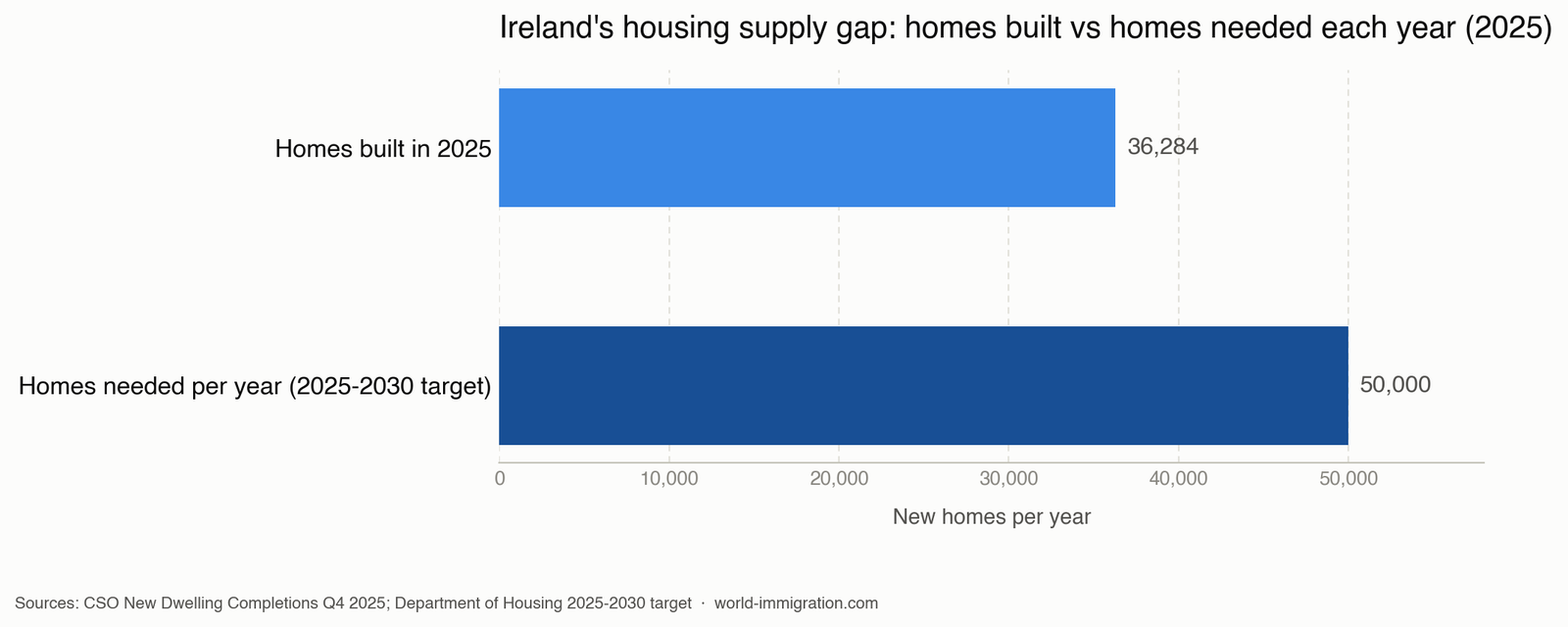
The cause is supply and the arithmetic is unforgiving. Ireland builds roughly 36,000 homes a year (a record 36,284 completed in 2025, per the CSO) against an estimated need of around 50,000 a year, the Department of Housing’s own target for 2025-2030. The Department of Finance projects the shortfall will persist for at least another 15 years.
This is why the crisis reads as structural: it is not waiting on the next interest-rate turn, it is waiting on a decade of construction that has not happened yet. Homelessness ran above 16,000 people a month through 2025 and has run above 17,000 every month since January 2026, per the Department of Housing’s monthly homelessness reports. Focus Ireland’s own research finds most family homelessness now stems from eviction out of an otherwise-stable private tenancy, commonly because the landlord is selling up — not simply never being able to afford rent in the first place — which tells you the pressure has moved well beyond the margins.
The practical consequence for anyone considering the move: do not arrive without accommodation arranged and do not assume a job offer solves it. What I’d do here is treat securing somewhere to live as the first priority rather than a formality that follows the visa and the job. If your employer provides or subsidises housing, or you already have a base with family, Ireland’s other advantages become reachable. If you are landing cold into the open market, the challenge above is what you are walking into.
Healthcare: a public system most people top up privately
Ireland’s healthcare is a two-tier arrangement and understanding it prevents a common misread. There is a public system run by the HSE and there is a large private insurance market operating alongside it — and carrying both is normal, not a sign the public system has failed.
The public side struggles most with waiting times. The government’s Waiting Time Action Plan 2026 sets targets of ten weeks for an outpatient appointment and twelve weeks for inpatient or day-case treatment. Against those targets, the actual outpatient waiting list stood at 611,987 patients awaiting a first consultant assessment as of December 2025, per the National Treatment Purchase Fund’s own waiting list data, with performance not improving into 2026. The plan exists precisely because the gap between target and reality is wide.
That gap is why private insurance is so widespread. Around 46% of the population — about 2.55 million people — held private health cover at the end of 2025, up 1.2% on the year, with average premiums rising more than ten percent over the same period. Almost half the country pays twice, in effect, to buy shorter waits and elective certainty. If you are coming from the UK’s NHS model, budget for this as a standing cost rather than a luxury.
One more difference that surprises British arrivals: GP visits are not free. Expect to pay roughly €45 to €70 out of pocket per visit unless you hold a Medical Card or GP Visit Card. Medical Cards are means-tested; a GP Visit Card is automatic regardless of income if you are under 8 or 70 and over and means-tested only for ages 8 to 69, per the HSE’s GP Visit Card eligibility rules. I’d lean toward treating both private insurance premiums and routine GP fees as line items in your monthly budget from day one, because neither is optional in the way NHS-conditioned expectations assume.
The weather is an adjustment, not a hardship
Ireland’s climate is often oversold as grim. However by internationals standards, temperatures are gentle year-round — January and February average four to seven degrees, July and August fourteen to sixteen, per the climate figures collated on Wikipedia’s Climate of Ireland entry. There is no harsh winter and no genuine heat. The adjustment is not cold; it is the persistent damp and cloud.
Rainfall varies more than newcomers expect and where you settle changes the experience. Dublin, on the drier east, sees roughly 700 to 900mm of rain a year across about 128 to 151 wet days, per the climate figures collated on Wikipedia’s Climate of Ireland entry. Cork and the west coast are markedly wetter — Cork runs around 1,000 to 1,230mm across roughly 210 wet days and the national range of wet days stretches from about 151 a year on the east and southeast coast to around 225 on the west.
So the choice between a Dublin base and a west-coast one is partly a choice about how many grey damp days you are signing up for. The scenery is best in the west; the drier weather is in the east. That is a genuine trade-off, not a rounding error.
Cost of living against the UK and US
Cost deserves only a brief pass here, because it has its own dedicated article, which carries the sourcing for these figures. In summary: cost-of-living comparison trackers put Ireland at roughly 12 to 16% more expensive than the UK overall, with groceries in particular — especially imported goods — sitting higher than British equivalents. Dublin is the exception that complicates the headline, comparing as meaningfully cheaper than London on typical cost-of-living indices, largely because London is an outlier at the top.
The way I’d go on cost is to separate rent from everything else. Once housing is secured, day-to-day spending in Ireland is comparable to Britain and generally kinder than a US coastal city. It is the rent, again, that dominates the sum. For the detailed breakdowns, see the separate Cost of Living in Ireland and Cost of Living in Dublin guides.
So, is Ireland a good place to live?
Directly, then. Ireland suits you if you arrive with housing solved — an employer arrangement, family, or a budget that absorbs €2,000-plus a month for a modest Dublin flat without strain. It suits people who value safety, sociability and landscape over sun and who can treat private health cover and GP fees as normal costs. For a skilled professional with a job lined up and accommodation arranged, the top-five safety ranking, the reversed brain drain and the open community make it a strong choice and the government is openly courting exactly that person through its diaspora strategy.
Ireland does not suit someone arriving cold into the rental market on an ordinary budget, hoping to sort housing after landing. The numbers make that a gamble with poor odds and the homelessness figures show the downside is not theoretical. Nor does it suit anyone who needs reliable sunshine or fast elective healthcare without paying privately for it.
The country’s virtues are genuine and its central problem is genuine too. Get the housing question answered first and the rest of Ireland is very much worth the move.
This article is part of our Ireland cluster, which covers the full move end to end.
Frequently asked questions
Is Ireland a good place to live for expats?
For skilled arrivals with a job and accommodation arranged, yes — Ireland ranks fifth on the 2026 Global Peace Index, has a strong community reputation and reversed its skilled-worker brain drain by 2018 (the last year the CSO published this breakdown), gaining roughly 22,700 more educated migrants than it lost. The one condition that overrides the rest is housing: expats arriving without somewhere to live face a rental market with under 1,800 homes listed nationally and a one-to-two percent vacancy rate.
Why is housing so hard to find in Ireland?
It is a supply problem. Ireland builds around 36,000 homes a year (a record 36,284 completed in 2025, per the CSO) against an estimated need of 50,000 and the Department of Finance expects the shortfall to persist fifteen or more years. That structural gap produced fewer than 1,800 rental listings nationally in February 2026, a 22% year-on-year fall and the lowest since Daft.ie’s records began in 2006.
Is healthcare free in Ireland?
Not in the NHS sense. There is a public HSE system, but GP visits typically cost €50 to €70 unless you hold a Medical Card or GP Visit Card and public waiting lists are long — 611,987 patients were awaiting a first outpatient assessment in December 2025. Around 46% of the population carries private health insurance to shorten waits, which is standard practice rather than an exception.
Does it rain all the time in Ireland?
It rains often but rarely heavily and the amount depends on where you settle. Dublin on the east sees roughly 700 to 900mm across about 128 to 151 wet days a year, while Cork and the west coast run wetter at around 1,000 to 1,230mm across roughly 210 wet days. Temperatures stay mild year-round — four to seven degrees in winter, fourteen to sixteen in summer — so the adjustment is the persistent grey and damp, not cold.

